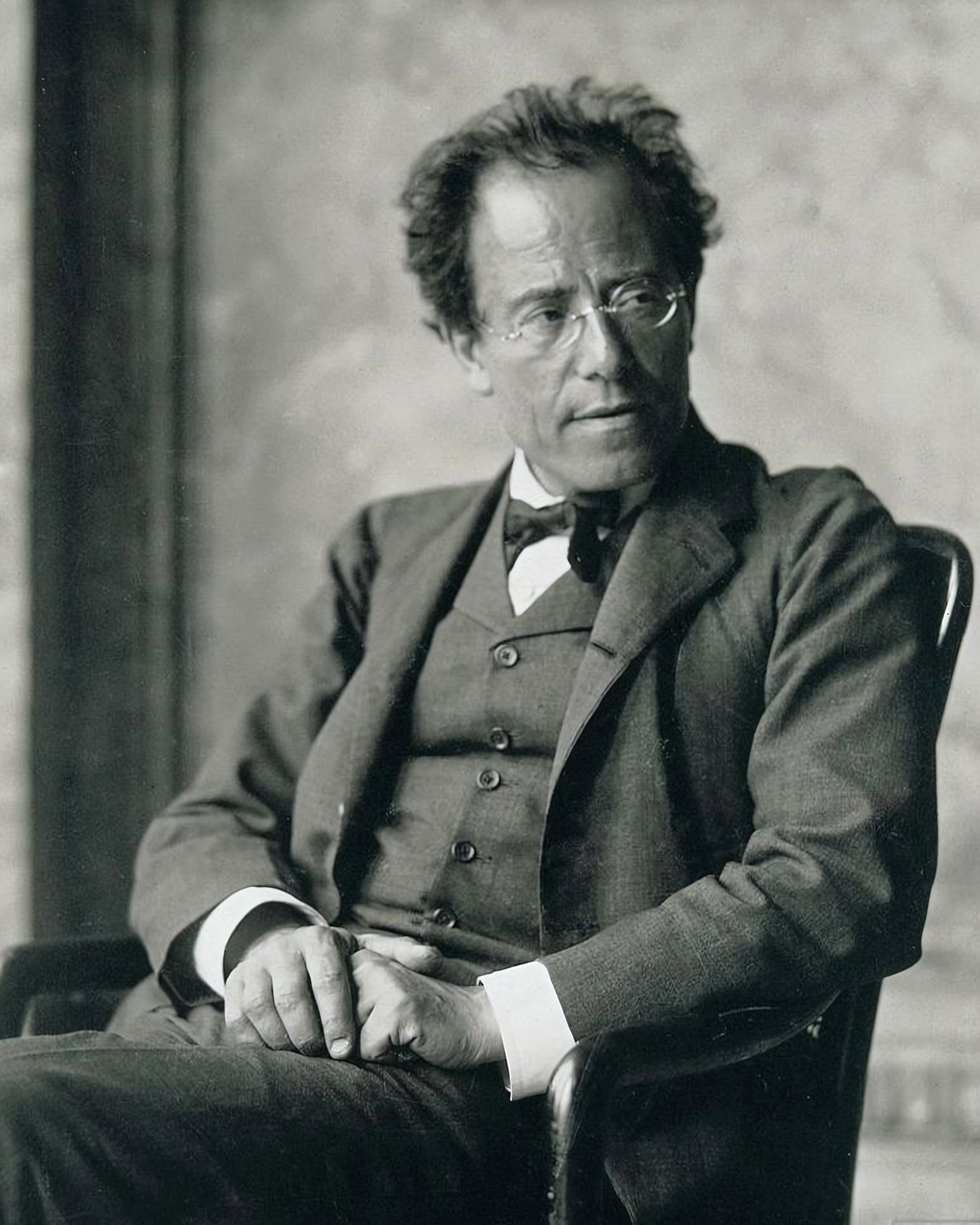
Gustav Mahler was born in Kalischt (Bohemia, then Austrian Empire) in 1860 and trained at the Vienna Conservatory from age fifteen. His career split cleanly in two: in season, he was one of Europe's most demanding opera conductors, building his reputation through posts in Kassel, Prague, Leipzig, Budapest, and Hamburg before reaching the directorship of the Vienna Court Opera in 1897: the most powerful conducting position on the continent.
Composition was a summer ritual. In secluded huts on the Attersee, then the Wörthersee, he wrote nine completed symphonies, one unfinished tenth, the song-symphony Das Lied von der Erde, and several major song cycles: Kindertotenlieder, Rückert-Lieder, Lieder eines fahrenden Gesellen. The output is small in number but enormous in scale: the Symphony No. 8 of 1906 calls for over a thousand performers and earned its nickname "Symphony of a Thousand."
His orchestration treats every instrument as a character. Strings whisper folk songs above military bass drums ; a children's choir punctuates a setting of medieval Latin ; a solo posthorn carries an entire movement's emotional weight. Mahler said his symphonies "must be like the world", they accommodate funeral marches, peasant dances, alpine birdcalls, and ecstatic choral apotheoses, often within consecutive movements.
He left Vienna in 1907 after years of antisemitic press attacks, took the principal conductorship of the Metropolitan Opera and then the New York Philharmonic, and conducted both while continuing to write the Ninth Symphony and sketch the Tenth. Returning to Vienna in 1911 with a streptococcal infection diagnosed in New York, he died at 50, days before the premiere of his Ninth.
His reputation was reactivated in the 1960s by conductors Leonard Bernstein, Bernard Haitink, Pierre Boulez, and others. The "Mahler boom" never really ended: today his symphonies are repertoire staples, his influence on Schoenberg, Berg and Webern is widely acknowledged, and his Adagietto (the slow movement of Symphony No. 5) is one of the most familiar pieces of orchestral music in the world.
Key works
- 1888
Symphony No. 1 in D major "Titan"
Four movements of late-romantic exuberance with a famous double-bass funeral march on a minor-key "Frère Jacques."
- 1894
Symphony No. 2 in C minor "Resurrection"
Ninety minutes, five movements, soprano + alto soloists + chorus. The work that made his reputation as a symphonist.
- 1904
Kindertotenlieder
Song cycle on five poems by Friedrich Rückert about the death of his children, written years before Mahler's own daughter Maria died at four.
- 1902
Symphony No. 5 in C-sharp minor
Five movements opening on a funeral march trumpet call. The fourth movement, Adagietto for strings and harp alone, became iconic via Visconti's 1971 film "Death in Venice."
- 1906
Symphony No. 8 in E-flat "Symphony of a Thousand"
Two parts: the Latin hymn "Veni Creator Spiritus" then the closing scene of Goethe's Faust. Premiered in Munich 1910 with Mahler conducting.
- 1909
Das Lied von der Erde
Symphony for tenor, alto and orchestra on Tang dynasty poems translated by Hans Bethge. Mahler's East-meets-West farewell, he avoided calling it his "Ninth" to dodge the Beethoven curse.
- 1909
Symphony No. 9 in D major
His true last completed work. The closing Adagio, strings dissolving into silence, is widely heard as a farewell to the late-romantic symphonic tradition itself.
Why this matters to Louis
Mahler is the reason Louis writes long-form. The lesson: a single piece can carry the weight of an entire emotional life if its arc is built like a story, with seeds planted in the first bar that bloom in the last.
"A symphony must be like the world. It must embrace everything."