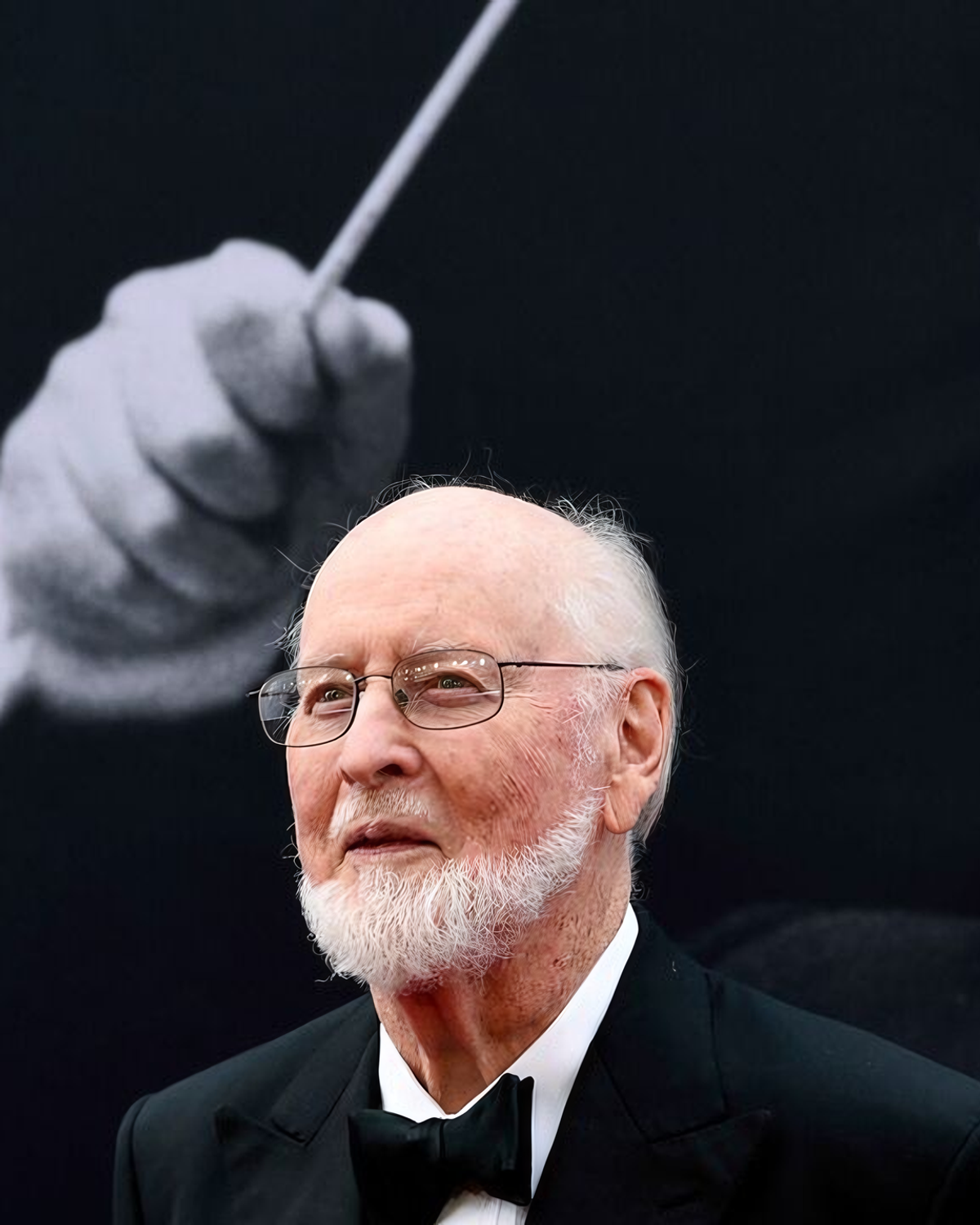
John Towner Williams was born in Floral Park, New York in 1932, son of a jazz drummer. He studied piano at Juilliard with Rosina Lhévinne and worked as a studio pianist in Los Angeles in the 1950s, playing on scores by Henry Mancini and others before moving to composition.
His early film work was steady but unremarkable until 1974, when Steven Spielberg hired him for The Sugarland Express. The partnership that followed, over thirty films across five decades, became the most consequential composer-director collaboration in cinema history, alongside Bernard Herrmann's work with Hitchcock.
Williams almost single-handedly revived the symphonic film score in the late 1970s, after a decade of pop-led soundtracks. His scores for Jaws (1975), Star Wars (1977), Close Encounters of the Third Kind (1977) and Superman (1978) reset the audience's ear for what cinema could sound like. The leitmotif system, the full orchestra, the singable themes: all returned, written with concert-hall craft.
He directed the Boston Pops Orchestra from 1980 to 1993 in addition to his film work, premiering and recording new music alongside the orchestral repertoire. His concert works, including violin, oboe, horn, harp, cello and trumpet concertos, sit comfortably in the late-romantic tradition while remaining unmistakably his.
With over 50 Academy Award nominations across more than six decades, he is the most nominated living person in any Oscar category. His work continues into his nineties, Indiana Jones and the Dial of Destiny (2023) was his latest major score. Beyond the famous themes, his orchestration carries the inheritance of Korngold, Wagner and Holst: every cue is voiced with precision even when scoring a chase scene.
Key works
- 1975
Jaws
Two notes. The simplest leitmotif in modern cinema, and the one that proved Williams could weaponise restraint.
- 1977
Star Wars
The score that re-symphonised Hollywood. Every leitmotif is now part of cultural memory ; the main theme is one of the most recognised pieces of music written in the 20th century.
- 1977
Close Encounters of the Third Kind
Five-note communication motif. A score where the music IS the alien language.
- 1981
Indiana Jones (Raiders of the Lost Ark)
The "Raiders March": an instant heroic theme written in the tradition of Korngold's swashbucklers.
- 1982
E.T. the Extra-Terrestrial
Adventure scoring at its most emotional. The "Flying Theme" remains Williams's most quoted melody after Star Wars.
- 1993
Schindler's List
Restraint as power. The solo violin (Itzhak Perlman) carries the entire emotional load. Williams's second Best Original Score Oscar.
- 1998
Saving Private Ryan
"Hymn to the Fallen": choral and orchestral elegy that became standard repertoire at military memorials.
- 2005
Memoirs of a Geisha
Solo cello (Yo-Yo Ma) + solo violin (Itzhak Perlman) over a Japanese-inflected orchestral palette. Williams scoring outside his usual idiom.
Why this matters to Louis
Williams is the proof that a melody you can sing AND a partition you can study are the same skill. Louis aspires to write themes that survive a single hearing.