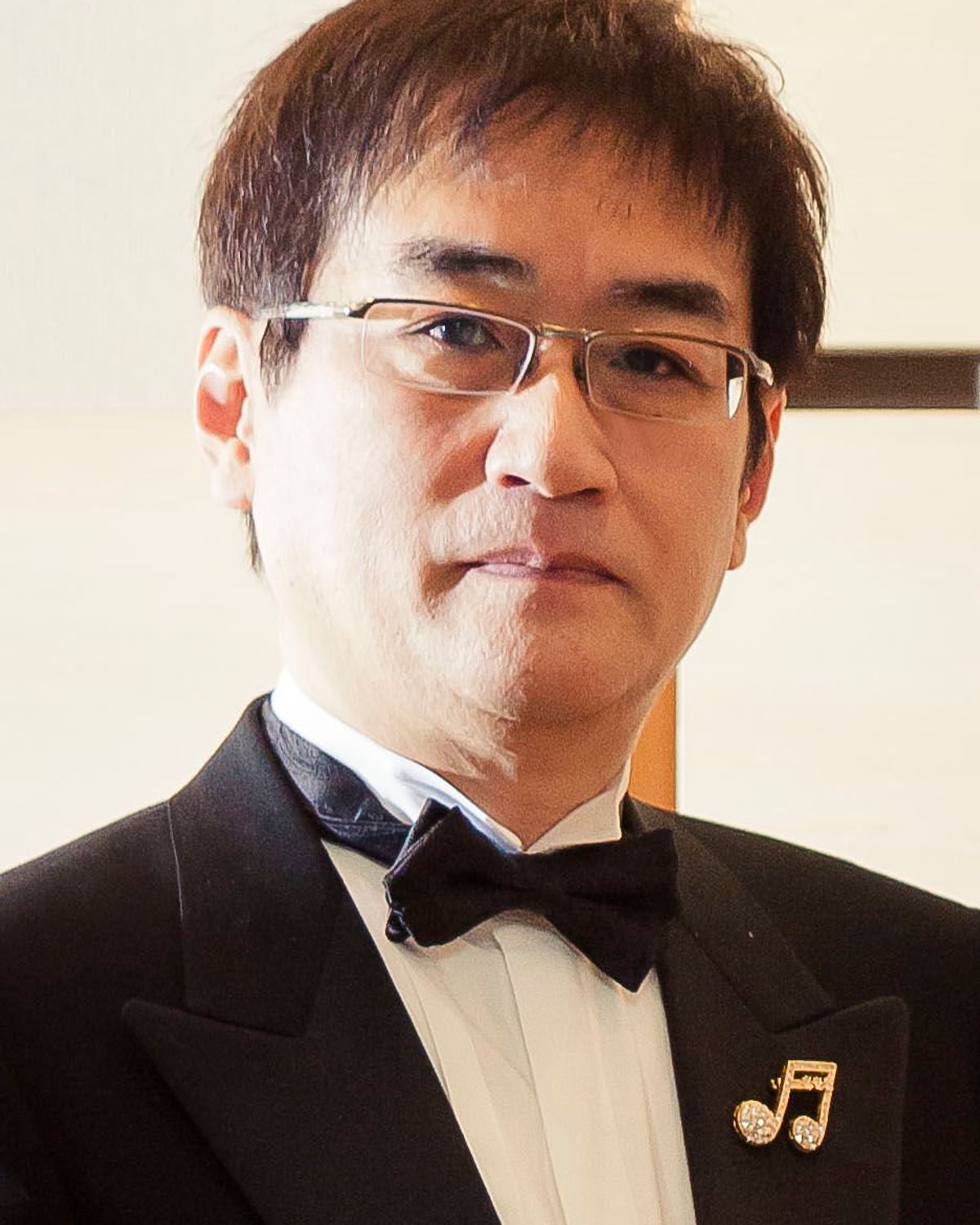
Kōhei Tanaka was born in Tokyo in 1954 and emerged as a composer in the late 1970s, scoring TV anime, OVAs and live-action drama in roughly equal measure. He developed early on a habit of treating each project not as a standalone score but as a world whose musical vocabulary could grow over time.
His Gunbuster (1988), an early Hideaki Anno project, already showed the long-arc thematic patience that would define his later work. The cues come back, varied and transformed, across the six episodes ; the listener who pays attention is rewarded with thematic continuity rather than dramatic punctuation.
In 1999 he was hired to score One Piece, a Toei Animation series adapting Eiichirō Oda's manga. The series is still running. Tanaka's score has grown alongside it for 25+ years, with cues introduced as background music in early arcs returning as climactic statements hundreds of episodes later. The "Overtaken" theme, written for the late Marineford arc, is one of the most quoted pieces of music in modern Japanese pop culture.
Outside One Piece he scored Sakura Wars (1996), Adieu Galaxy Express 999 (1981), and dozens of other projects. He frequently conducts his own scores live, presenting them in concert form to audiences that already know every cue by heart. The Symphonic Concert tours of his One Piece music routinely fill major Japanese venues.
Key works
- 1981
Adieu Galaxy Express 999 (Film score)
Early career work for Leiji Matsumoto's space-opera anime. Already showing his preference for sustained themes over genre cliché.
- 1988
Gunbuster (OST)
Early Hideaki Anno project. The thematic patience here predicts the long-arc One Piece scoring twelve years later.
- 1996
Sakura Wars (OST)
Cross-media franchise score. Theatrical, march-driven, unmistakable.
- 1999–
One Piece (OST, ongoing)
A 25-year score that became the soundtrack of a generation. Tanaka's ability to make a single theme carry hundreds of variations is the work's spine.
- 2010
One Piece: Overtaken
Cue from the Marineford arc. The most quoted piece of his catalogue and arguably the most iconic single piece of music in 21st-century anime.
Why this matters to Louis
Tanaka is the proof that long-form scoring is a discipline of its own. Louis is building Mastaia with the same long-view philosophy: a world's music should outlive its first cycle.