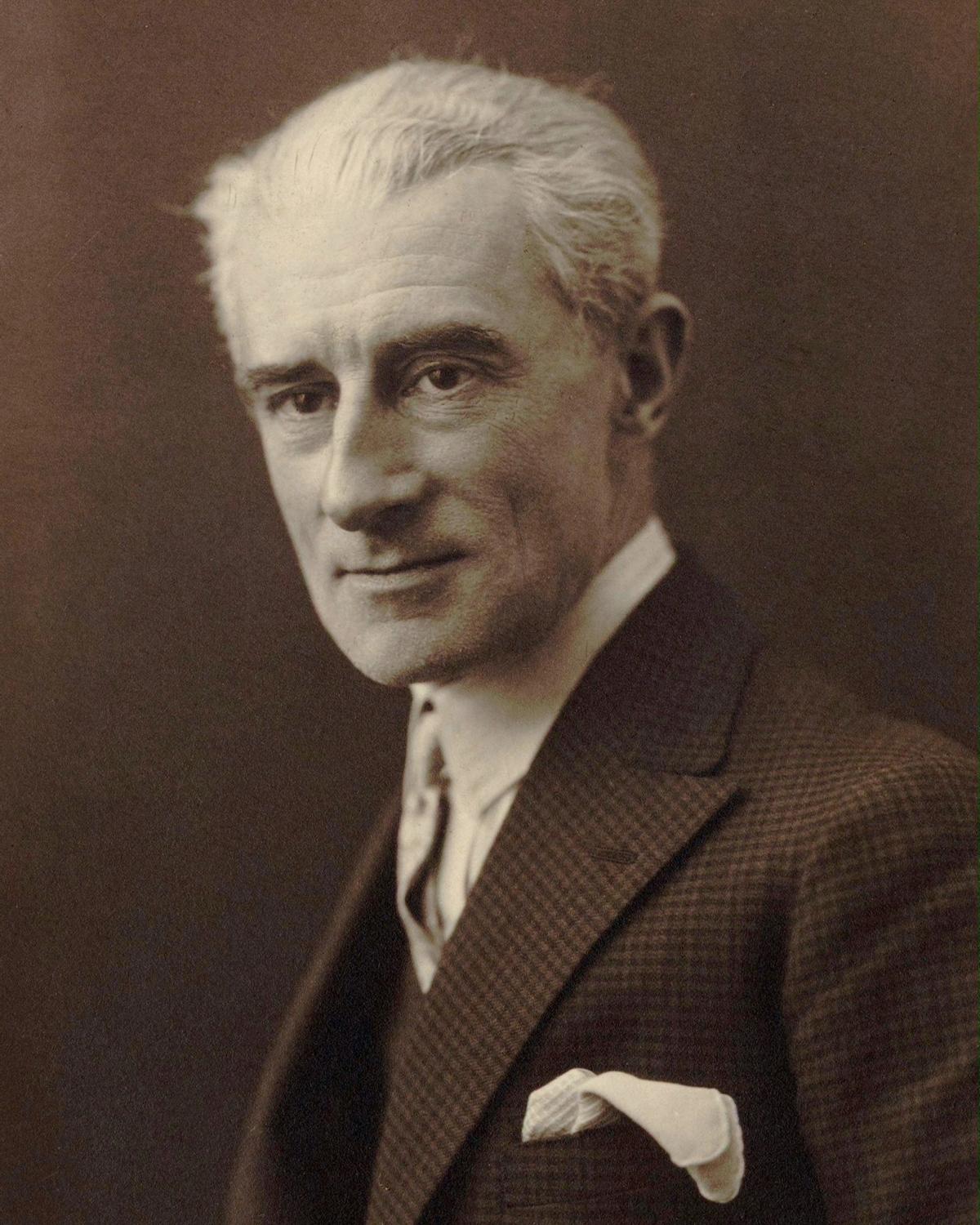
Maurice Ravel was born in 1875 in Ciboure, in the French Basque country, to a Swiss engineer father and a Basque mother. The family moved to Paris when he was three months old. He entered the Paris Conservatoire at fourteen and stayed for sixteen years, first as a piano student under Charles de Bériot, then in composition with Gabriel Fauré.
His Conservatoire years were turbulent. He competed for the prestigious Prix de Rome five times between 1900 and 1905 and never won, the final rejection in 1905, when he was eliminated in the preliminary round despite already being a known composer, sparked the "Ravel Affair" and led to the resignation of the Conservatoire director.
He wrote slowly and discarded what didn't reach his standards. The catalogue remains relatively small, about 60 works, but every score is polished to a goldsmith's finish. His orchestrations (both of his own piano music and of others, most famously Mussorgsky's Pictures at an Exhibition in 1922) became the textbook examples of orchestral clarity: even at maximum volume every line is audible.
World War I broke him physically. Determined to serve despite being underweight and over-aged, he eventually worked as a truck driver near the Verdun front. His mother died in 1917 ; he wrote almost nothing during the war years. The post-war Boléro (1928), one theme, one crescendo, fifteen minutes, became his most popular work, much to his bemusement ; he called it "a piece for orchestra without music."
In 1932 he was injured in a taxi accident in Paris. He gradually lost the ability to write, then to speak. He died in 1937 after an unsuccessful brain operation, possibly to treat what we would now recognise as Pick's disease. He never married, lived most of his life alone, and left behind the most quietly perfect orchestral output of his generation.
Key works
- 1899
Pavane pour une infante défunte
Originally for piano ; orchestrated 1910. Title is an aristocratic nonsense ("Pavane for a dead princess") that Ravel later disowned, but the music remains his calling card.
- 1908
Rapsodie espagnole
Four orchestral movements distilling Spanish dance forms. The "Feria" finale is a textbook of orchestral sonority.
- 1912
Daphnis et Chloé
Ballet score for Diaghilev's Ballets Russes. The "Daybreak" passage is the textbook page for orchestral sunrise.
- 1917
Le Tombeau de Couperin
Six piano pieces (later orchestrated as four), each movement dedicated to a friend killed in WWI.
- 1920
La Valse
Vienna waltz pushed past elegance into vertigo. Originally intended as a ballet for Diaghilev, who rejected it.
- 1922
Pictures at an Exhibition (orchestration of Mussorgsky)
Commissioned by Serge Koussevitzky. The orchestration that effectively replaced the original in concert repertoire.
- 1928
Boléro
One theme, one crescendo, fifteen minutes. Pure orchestration as content. His most popular work, written almost as a joke about orchestral mechanics.
- 1931
Piano Concerto in G major
Three movements with a luminous slow middle Ravel said he wrote "two bars at a time, with the help of Mozart and Saint-Saëns."
Why this matters to Louis
Ravel teaches discipline: that the cleanest gesture, perfectly voiced, beats three messy ideas competing. Louis returns to his scores when his own writing gets cluttered.
"My objective is technical perfection. I can strive unceasingly to this end, since I am sure of never being able to attain it."