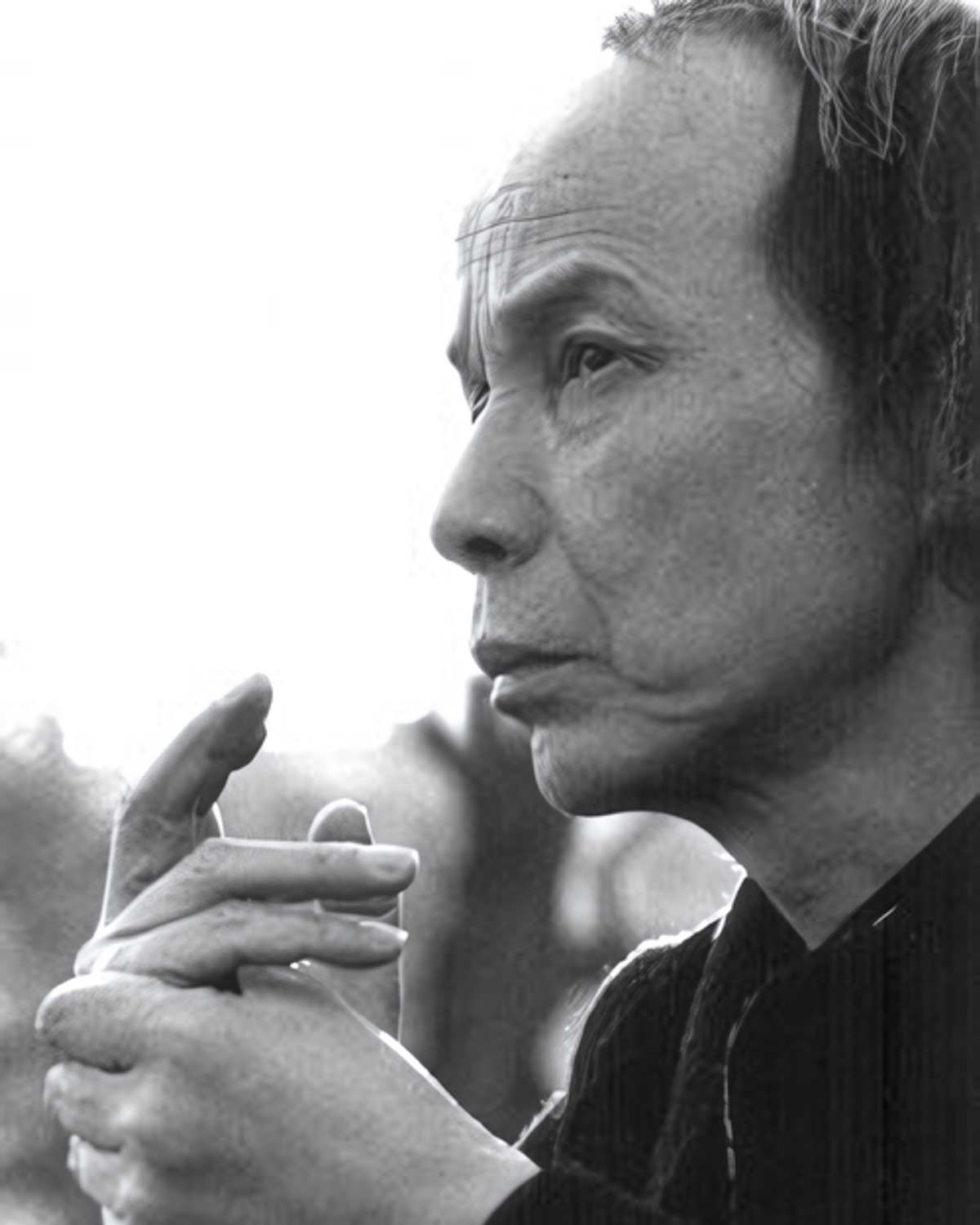
Tōru Takemitsu was born in Tokyo in 1930. He was largely self-taught: his musical education came from clandestine record listening during the American occupation, when Western classical music finally became accessible to Japanese audiences. He recoiled at first from traditional Japanese music, associating it with wartime nationalism, and only embraced it in the 1960s.
In 1951 he co-founded Jikken Kōbō (Experimental Workshop), a multidisciplinary collective in Tokyo that brought together composers, visual artists, poets and choreographers. The group treated all art forms as one continuous practice, a working method Takemitsu carried throughout his career.
His international breakthrough came in 1959 when Igor Stravinsky, visiting Japan, heard the Requiem for Strings by chance on a record producer's playback and declared it a masterpiece. From that moment, Western festivals and commissions came regularly. He never stopped working in cinema in parallel: he wrote over 100 film scores including for Akira Kurosawa (Ran, Dodes'ka-den), Masaki Kobayashi (Hara-kiri, Kwaidan), and Hiroshi Teshigahara (Woman in the Dunes).
In November Steps (1967), commissioned by the New York Philharmonic, he placed two traditional Japanese instruments, biwa and shakuhachi, as soloists against the Western orchestra and refused to integrate them harmonically. The piece asks the two traditions to coexist without dissolving each other. It became one of the defining works of cross-cultural modernism.
He kept writing concert and film music in parallel until his death from bladder cancer in 1996. His later works often took garden imagery as their structural metaphor, A Flock Descends into the Pentagonal Garden, In an Autumn Garden, Garden Rain. The music asks the listener to slow down, to hear silence as material, to perceive time as something composed.
Key works
- 1957
Requiem for Strings
The piece Stravinsky championed after a chance hearing in Tokyo. Takemitsu's international breakthrough at age 27.
- 1964
Woman in the Dunes (Film score)
Score for Hiroshi Teshigahara's existential masterpiece. Won the Cannes Special Jury Prize ; Takemitsu's film breakthrough in the West.
- 1967
November Steps
Concerto for biwa, shakuhachi and orchestra. Commissioned by the New York Philharmonic for its 125th anniversary. The cultural collision distilled.
- 1977
A Flock Descends into the Pentagonal Garden
Orchestral piece inspired by a dream Takemitsu had after visiting a Japanese garden. Time moves at the speed of contemplation.
- 1985
Ran (Film score)
Akira Kurosawa's King Lear in feudal Japan. The score uses Noh theatre conventions inside symphonic writing.
- 1994
Spirit Garden
Late orchestral work. The garden metaphor at its most refined, a piece that breathes rather than progresses.
Why this matters to Louis
From Takemitsu, Louis takes the conviction that silence is composed: that what you choose NOT to write is as much craft as what you write. The ear hears the held breath.
"I would like to compose music as natural as the sound of rain."